What red flags mean I should walk away from a contractor?
Walk away if a contractor asks for an illegal deposit, has a license that won't verify, wants to skip the permit, or won't put the price in writing.
- California caps a home improvement deposit at $1,000 or 10% of the contract price, whichever amount is less.
- Check any contractor's license free at cslb.ca.gov before you sign.
- Home improvement jobs over $500 need a written contract.
- Never let a contractor talk you out of a required permit.
- Pay with a traceable method, never cash only.
Red flag 1 · The depositWhat does it mean when a contractor asks for a big deposit up front?
A deposit bigger than California allows means you should stop before you pay. The legal cap on a home improvement deposit is whichever of these is less, no matter how the project is priced (CSLB):
- $1,000, or
- 10% of the contract price.
A contractor asking for half, or "a few thousand to get started," is either unlicensed, doesn't know the law, or is counting on you not knowing it. On our jobs, you get a written estimate before any work starts.
Red flag 2 · The licenseWhy does a license number that won't verify matter?
A license number that won't verify at cslb.ca.gov means the protection that comes with a license is gone. The lookup is free and shows:
- whether the license is current,
- what class of work it covers,
- whether there's a bond, and
- whether there's a disciplinary record.
Valley Home Construction holds CSLB license #982830, and you can check that number tonight without calling us first. A contractor who resists the check, or whose number comes back with someone else's name, isn't someone to hire.
Red flag 3 · The permitWhat if a contractor pushes you to skip the permit?
A contractor who pushes you to skip a required permit is handing the risk to you. Skipping it to save a few days or a few dollars can leave you with:
- work that fails inspection later,
- a harder sale when you move, and
- a problem insurance won't stand behind if something goes wrong.
As our process page says, we pull the permits and deal with the city, so you never stand in a line. A contractor who suggests cutting that corner is asking you to take on a problem that's supposed to be theirs.
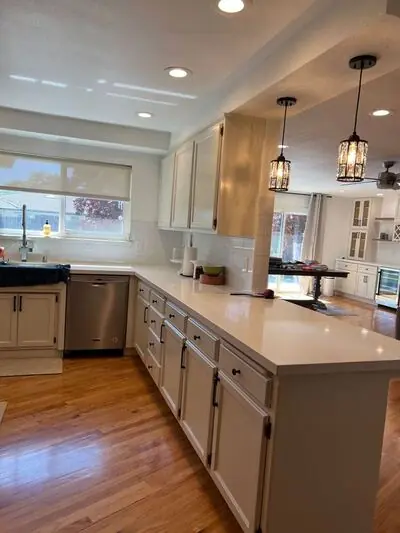
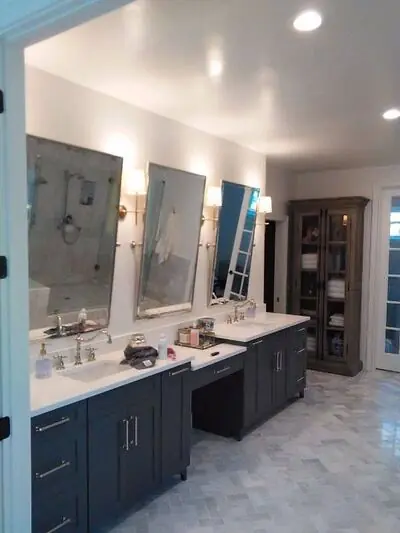
our own crew and vans, on real jobs
"Ed Lane and his team displayed exceptional professionalism and craftsmanship... The team is incredibly skilled, friendly, and communicative, making the whole process smooth and stress-free."
Red flag 4 · The contractWhat if there's no written contract, or the contract is vague?
Without a written contract there's nothing to hold the job to. California requires one on any home improvement job over $500 (CSLB), and it has to:
- describe the work,
- carry a payment schedule,
- name who pulls the permits,
- give a completion date, and
- list the contractor's license number.
Get an itemized written estimate before demo starts, and ask that every change be priced and approved in writing first. A verbal agreement, a one-page estimate or a contract with blank sections is a reason to ask for a real one before you sign anything.
Red flag 5 · The paymentShould a cash-only demand worry you?
A cash-only demand is worth a pause. Paying cash is legal, but a contractor who wants cash only, with no check, no card and no paper trail, is also avoiding the record that protects you if a dispute comes up. Two things protect you instead:
- a contract that spells out a clear payment schedule, and
- paying through normal, traceable methods, so there's a record of what was paid, when, and for what.
"I especially appreciated the daily communication & updates as the project progressed."
Red flags to check before you sign
- A deposit over $1,000 or 10% of the contract price, whichever is less, breaks California law.
- Look up the license number at cslb.ca.gov before you sign anything.
- Keep every required permit, even if a contractor says to skip it.
- Get a written contract for any home improvement job over $500.
- Pay through traceable methods so there's a record of every payment.
Questions people ask about contractor red flags
Is it a red flag if a contractor asks for half the money upfront?
How do I check if a California contractor's license is real?
What should be in writing before I let a contractor start?
Is it a red flag if a contractor tells me to skip the permit?
Should I worry if a contractor only takes cash?





How we verified this page
What we checked, what we couldn't, and who read it.
Published by Valley Home ConstructionChecked Sep 24, 20263 sourcesReported with AI
What this page is for
It helps a Sacramento-area homeowner spot a contractor who isn't going to work out, before signing a contract or paying a deposit.
Who we wrote it for
A homeowner with a bid in hand, comparing contractors, or wondering if a deposit already paid was legal. It doesn't serve someone who has already signed with a contractor they trust and has no specific concern.
Our lens
We're a licensed Sacramento remodeler. We make money when a homeowner hires us, so we have a reason to want the bar for who to hire set where it actually protects the homeowner, even when that doesn't favor us. We'd gain if a reader compares a shady bid against a legal one and calls us instead.
Key facts
| Fact | Detail | Source, checked |
|---|---|---|
| Deposit cap | The lesser of $1,000 or 10% of the contract price | CSLB, Sep 24, 2026 |
| Written contract | Required by law on any home improvement job over $500 | CSLB, Sep 24, 2026 |
| License lookup | Free at cslb.ca.gov; shows status, classification, bond and any discipline | CSLB, Sep 15, 2026 |
| Valley Home Construction's license | CSLB #982830 | Valley Home Construction |
| In business since | 1995, in the Sacramento area | Valley Home Construction's website, which has said 1995 since at least 2012 |
How we researched it
We read the CSLB's consumer pages on home improvement contracts and deposit limits on Sep 15, 2026 and checked them again on Sep 24, 2026. How we run our own jobs comes from our process page. The two reviews on this page are quoted word for word from Google.
What we couldn't verify
Ed Lane hasn't reviewed this page yet; claims that needed his confirmation were removed. No reliable source gives a dollar figure for a typical bad-actor deposit, so this page describes patterns instead of inventing a number.
Decisions we made
- We led with the deposit cap because it's the easiest thing for a homeowner to check against a real bid.
- We left out a ranking of red flags by severity. Any one of these is reason enough to pause.
- We didn't name a deposit amount we charge, because this page isn't about our own pricing.
Who wrote it
Reported with AI. Every claim checked against its source. Published by Valley Home Construction. Ed Lane hasn't reviewed this page yet; claims that needed his confirmation were removed.
Dates
- Published Sep 15, 2026
- Last checked Sep 24, 2026
- Check again by Mar 15, 2027
Changes and corrections
- Oct 2, 2026: we traced every line about how we work, and every quote from Ed Lane, back to its source, and corrected the source for our founding year.
- Sep 24, 2026: Ed Lane hasn't reviewed this page yet; claims that needed his confirmation were removed. We removed a line about how our payment schedules work and now cite our process page for permits.
- Sep 24, 2026: new page layout. The byline now says published by instead of reviewed by, since no one at Valley Home Construction has read the page in full yet. We re-checked both CSLB rules at the source.
Sources
- CSLB, home improvement contract requirements, checked Sep 24, 2026.
- CSLB, homeowner checklists and deposit limits, checked Sep 24, 2026.
- Valley Home Construction, Our process page, checked Sep 24, 2026.