How much can a contractor legally ask for as a deposit in California?
California caps a home improvement deposit at $1,000 or 10% of the contract price, whichever is less, and special-order materials don't change that.
- On a $30,000 remodel, the legal deposit cap is still $1,000.
- Special-order cabinets, tile or fixtures don't raise the cap.
- Every later payment follows a written schedule tied to work done.
- A change to the price or scope needs a signed change order first.
- Ask for a revised schedule before you pay a deposit over the cap.
The ruleWhat does California law say about a contractor's deposit?
The Contractors State License Board puts the rule in one sentence: "The down payment cannot be more than $1,000 or 10 percent of the contract price, whichever is less, for a home improvement job or swimming pool, excluding finance charges" (CSLB). The words that matter are "whichever is less." Here's how that works out on a few contract prices:
| Contract price | 10% of it | Legal deposit cap |
|---|---|---|
| $5,000 | $500 | $500 |
| $10,000 | $1,000 | $1,000 |
| $30,000 | $3,000 | $1,000 |
Past a $10,000 contract, the cap stays at $1,000 no matter how big the job gets.
The exception people ask aboutCan special orders raise the deposit cap?
No. The CSLB says it plainly: "There are no exceptions for special-order materials." A custom range hood, imported tile or made-to-order cabinets don't give a contractor a legal reason to ask for more up front.
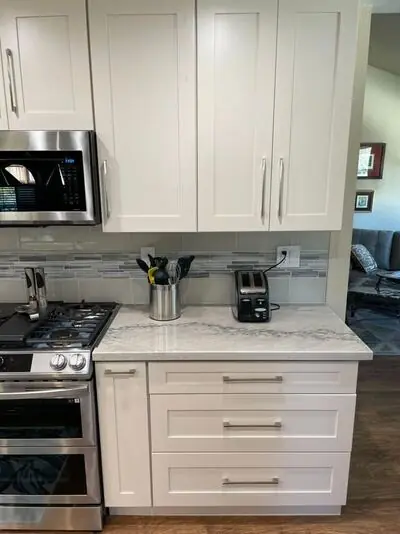
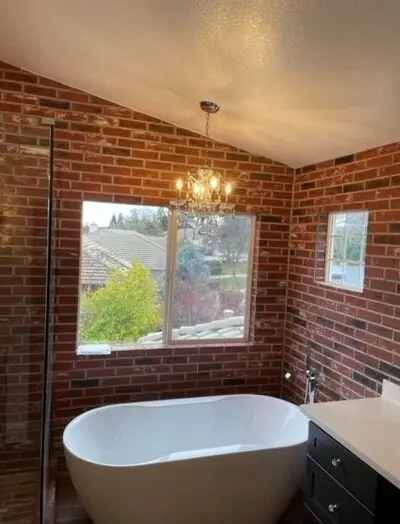
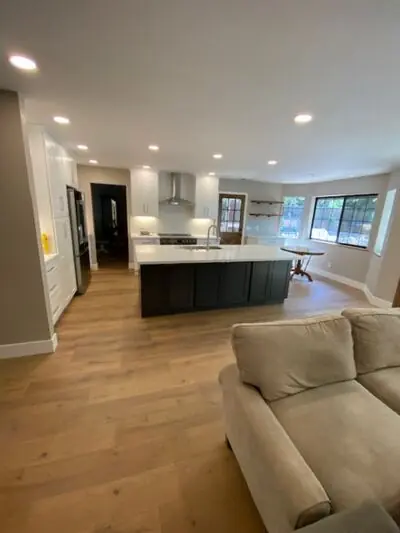
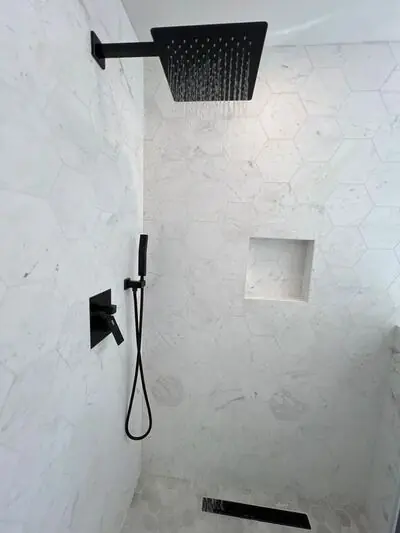
materials going in, on our own jobs
"Ed Lane and his team displayed exceptional professionalism and craftsmanship... The team is incredibly skilled, friendly, and communicative, making the whole process smooth and stress-free."
The rest of the moneyWhat can a contractor collect after the deposit?
Everything after the deposit runs on the payment schedule written into the contract. The CSLB sets three rules for it:
- the contract has to include a detailed, written payment schedule,
- payments can't exceed the value of the work performed, apart from the deposit, and
- you should pay only as work is completed, not before (CSLB checklist).
Any contract you sign with us has to follow those rules too, and you get a written estimate before any work starts.
ChangesWhat happens to the price if the scope changes?
A change to the price or the scope has to be written up as a change order, signed by you and the contractor before the change is made, and it becomes part of the contract (CSLB). A contractor who adds to the bill without one is skipping a step the law requires.
What to doWhat if a contractor already asked for more than the cap?
Don't pay it as asked. Three steps:
- Point to the CSLB rule and ask for a revised payment schedule that follows it.
- Look up the contractor's license for free at cslb.ca.gov.
- If the contractor won't adjust the deposit, get a second bid before you sign anything.
A contractor who fixes the schedule without a fight is showing good faith. One who insists on the higher number has told you something worth knowing before you sign.
"I especially appreciated the daily communication & updates as the project progressed."
What to know before you pay a deposit
- The deposit can't be more than $1,000 or 10% of the contract price, whichever is less.
- Special-order materials are not an exception to that cap.
- Payments after the deposit follow a written schedule and can't run ahead of the work.
- Any change to the price or scope needs a written change order signed before it happens.
- If a bid asks for more, ask for a schedule that follows the law before you pay.
Questions people ask about contractor deposits
What is the maximum deposit a contractor can ask for in California?
Does the deposit rule have exceptions for special-order materials?
Can a contractor ask for more money after the deposit?
What happens to the price if we change the scope mid-job?
What do I do if a contractor already asked for more than the legal deposit?





How we verified this page
What we checked, what we couldn't, and who read it.
Published by Valley Home ConstructionChecked Sep 24, 20262 sourcesReported with AI
What this page is for
It states the exact California legal limit on a home improvement contractor's deposit, so a homeowner can check a bid against it before paying.
Who we wrote it for
A Sacramento-area homeowner with a remodel bid in hand. It doesn't cover deposits on new home construction, which isn't a home improvement contract.
Our lens
We're Valley Home Construction, a licensed Sacramento general contractor. We make money when a homeowner hires us, so we have a reason to want homeowners comparing bids against the law, since the same law binds us. We quoted the state's words so you can check them yourself.
Key facts
| Fact | Detail | Source, checked |
|---|---|---|
| Deposit cap | The lesser of $1,000 or 10% of the contract price, excluding finance charges | CSLB, Sep 24, 2026 |
| Special-order materials | No exception; the cap still applies | CSLB, Sep 24, 2026 |
| Later payments | A detailed written schedule; payments can't exceed the value of work performed | CSLB, Sep 24, 2026 |
| Changes | A written change order, signed by both sides before the change | CSLB, Sep 24, 2026 |
| Valley Home Construction's license | CSLB #982830, general building contractor | CSLB license lookup, Sep 16, 2026 |
| In business since | 1995, in the Sacramento area | Valley Home Construction's website, which has said 1995 since at least 2012 |
How we researched it
We opened the CSLB's consumer pages on home improvement contracts on Sep 15, 2026 and again on Sep 24, 2026, and quoted the deposit rule in the Board's exact words.
What we couldn't verify
Ed Lane hasn't reviewed this page yet; claims that needed his confirmation were removed. A typical dollar amount for an out-of-line deposit request in Sacramento; no reliable source states one. We also removed an earlier line saying the same rule covers residential solar and ADU contracts, because we couldn't find it on the CSLB pages we checked.
Decisions we made
- We quoted the CSLB's own words instead of paraphrasing a number that could drift from the source.
- We worked the rule through a few contract prices in a table, since the 'whichever is less' part is where people get it wrong.
- We didn't state a deposit amount of our own, because this page is about the legal rule.
Who wrote it
Reported with AI. Every claim checked against its source. Published by Valley Home Construction. Ed Lane hasn't reviewed this page yet; claims that needed his confirmation were removed.
Dates
- Published Sep 15, 2026
- Last checked Sep 24, 2026
- Check again by Mar 15, 2027
Changes and corrections
- Oct 2, 2026: we traced every line about how we work, and every quote from Ed Lane, back to its source, and corrected the source for our founding year.
- Sep 24, 2026: Ed Lane hasn't reviewed this page yet; claims that needed his confirmation were removed.
- Sep 24, 2026: new page layout. We re-checked the rule at the source and now cite the CSLB page that carries the exact quote. We removed the solar and ADU line we couldn't verify, and the Ed Lane attributions that weren't in our interview notes.
Sources
- CSLB, home improvement contract requirements and the deposit rule, checked Sep 24, 2026.
- CSLB, homeowner checklists, checked Sep 24, 2026.